
More details to follow
Author: admin
-
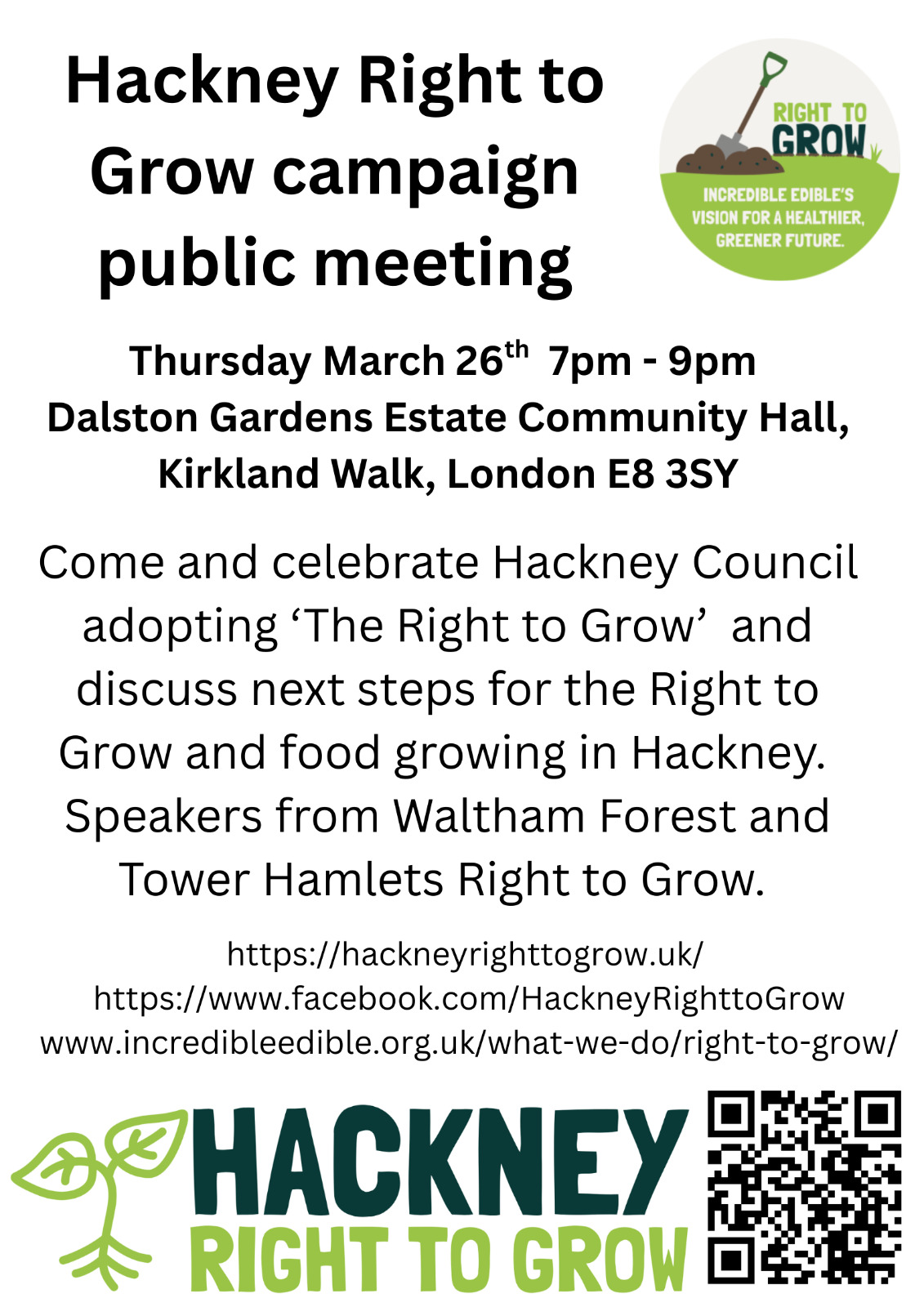
Hackney Right to Grow campaign public meeting
Thursday March 26th 7pm – 9pm
Dalston Gardens Estate Community Hall,
Kirkland Walk, London E8 3SY
Come and celebrate Hackney Council adopting ‘The Right to Grow’ and discuss next steps for the Right to Grow and food growing in Hackney.
Speakers from Waltham Forest and Tower Hamlets Right to Grow.
-
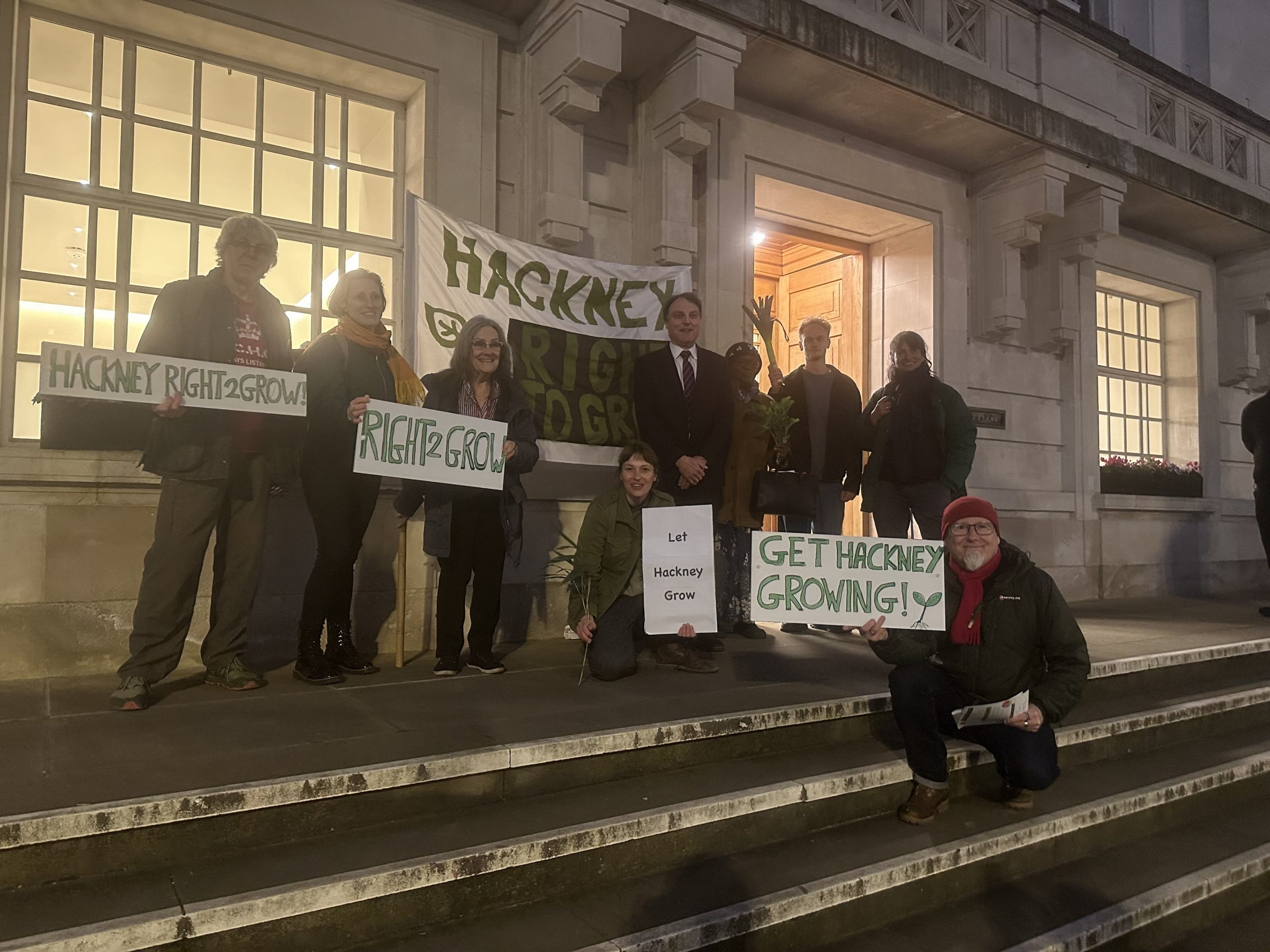
Hackney Council passes a Right to Grow motion
Community food growing campaigning group Hackney Right to Grow welcome the passing of a Right to Grow motion at the Hackney Full Council meeting on Wednesday 4th March 2026 and thank especially the proposer Cllr Lynne Troughton, seconder Cllr Gilbert Smyth and Cllr Sarah Young for their support through the whole process. We also thank the other Cllrs from Labour, The Independent Socialist Group and the Green Party who all spoke passionately in favour of the motion and about how important it is for Hackney residents to have access to food growing space.
The preamble of the motions states “Everyone in Hackney should have access to enough fresh food to feed themselves and their families well and this is all the more challenging during the cost of living crisis. The right to grow will provide a renewed focus on the importance of providing affordable healthy food and sustainable methods of producing the food we eat” and resolves to “Adopt the principle of “right to grow” on council-owned land that is
considered suitable in agreement with the Council”The Right to Grow means there is right or at least a presumption that unused and under-used land can be used for growing food (The Right to Grow motion Hackney has adopted comes from, with adaptions, the national Right to Grow movement, launched by Incredible Edible in 2022 ). Hackney communities have some of the least access to growing space in Britain with 10s of 1000s living in flats, with no access to anywhere to grow, and at the same time some of the highest levels of food poverty, so this is massively needed. Hackney Council has been great in supporting food growing on their housing estates but there are an incredible number, and area, of un- and under-used land in Hackney that could be used for growing food. Urban community food growing has massive benefits not just in getting good healthy food into the mouths of those who most need it, so mitigating food poverty and helping with social justice, and in increasing food resilience come future crises, but also in increasing community engagement, with helping with people’s physical and mental health, and directly confronting climate change by reducing reliance on carbon intensive food production, and providing significant benefits for biodiversity, not only in creating biodiversity hot spots in urban areas, but more importantly by reducing our consumption of food growing in biodiversity destructive modern agriculture.
Hackney Right to Grow also want to thank Pam Warhurst for starting this whole process and being our inspiration, and the national Right to Grow / Incredible Edible campaign and Sustain / Capital Growth for their support.
Glyn Harries, one of the Hackney Right to Grow group co-ordinators said “It’s great that Hackney Council have voted to adopt the Right to Grow principle and we hope to see a significant increase in food growing sites in the borough, bringing people together, getting healthy food for those that need it the most, with great biodiversity benefits and helping fight climate change”
Deba Salim, from The Garden of Earthly Delights and TimetoGrow! and Hackney Right to Grow co-ordinator stated “So pleased this long awaited motion has been passed finally! It’s high time to be growing food locally, and with it, building community resilience”.
Cllr Sarah Young, Hackney Council Cabinet Member for Climate, Environment and Transport reflected on “powerful speeches on the importance of growing our own food as part of our diverse cultural heritage – growing food that tastes of home in Hackney – as well as enjoying being active, eating well and cheaply and spending time with together and outdoors while we garden. She also thanked Cllr Lynne Troughton and the Hackney Right To Grow group for all their “…work on this. It was so good to end our full council with unanimous support for the right to grow across the council chamber. We have so many great gardening groups on Hackney’s estates and this motion starts the process of spreading the right to grow throughout the borough. Bring it on.”
Cllr Lynne Troughton added “I am so proud to have brought this motion which confirms our commitment to social and environmental justice. I look forward to working further with the campaigners that sparked the flame in me to get this over the line.”
-
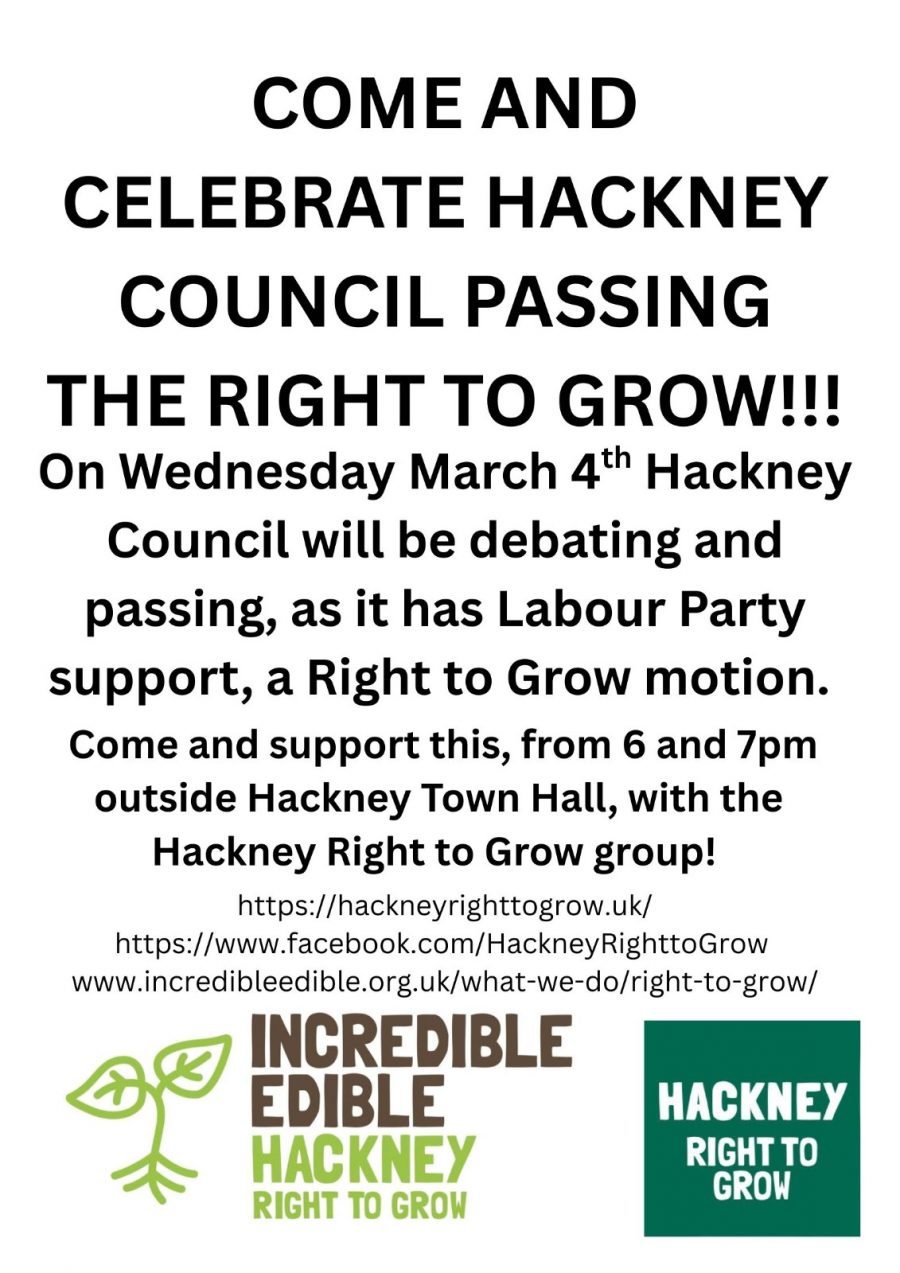
Hackney Council Town Hall – Wednesday March 4th – 6-7pm
Come and celebrate Hackney council passing a Right to Grow motion! Wednesday March 4th! 6-7pm outside the town hall!
Bring banners, placards and veg to wave!
-
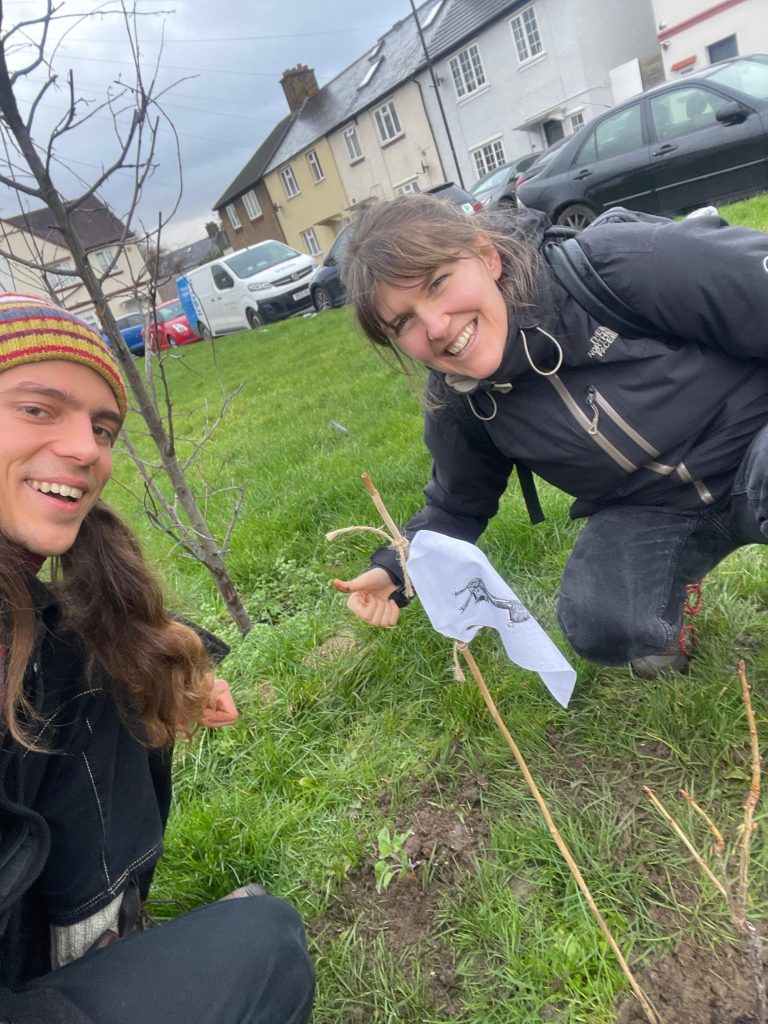
Waltham Forest residents plant on public land in borough-wide call for a Right to Grow
On Sunday 1 February, residents across Waltham Forest, London, came together in a coordinated borough-wide action to plant edible plants on unused public land, calling for a formal Right to Grow and greater council support for community food growing.
The action, organised by Waltham Forest Right to Grow, supported 18 community groups across the borough to plant food in public spaces. A total of 92 edible plants were distributed to more than 50 local residents, who worked in small groups to plant on underused land in their neighbourhoods.
The Waltham Forest action forms part of a growing national Right to Grow movement, which is calling on councils across the country to formally support residents to grow food on public land. Right to Grow motions have already been passed by councils including Hull and Southwark, with other local authorities exploring similar approaches as demand for community food growing continues to rise.
Campaigners say the issue is increasingly urgent. The action comes off the back of a recent UK government national security assessment warning that global biodiversity loss and ecosystem degradation pose a serious risk to UK food security, with rising exposure to crop failures, supply chain disruption, and global competition for food. The report highlights the need to strengthen local food resilience and ecosystem restoration as part of the UK’s response to these risks .
Organisers say the action was designed to demonstrate both the public demand for and the practical reality of a Right to Grow in Waltham Forest.
The Waltham Forest Right to Grow campaign is calling for:
- A clear and accessible process for residents to grow food on council-owned public land
- A dedicated community food officer role within the council
- A small start-up fund to support new and emerging community gardens
“People are already growing food, building community, and improving local spaces — often without any formal support,” said a spokesperson for Waltham Forest Right to Grow. “This action shows how much appetite there is for a Right to Grow, and how quickly it can turn unused land into something that benefits everyone.”
The local campaign says council response so far has not matched the level of public interest. Hundreds of residents have already signed up to support the campaign, and more than five new community gardens have formed as a direct result of the campaign in the borough in recent months.
“We’re seeing enormous enthusiasm from residents,” the spokesperson added. “What’s missing is a clear commitment from the council to support this energy and make food growing on public land easier, not harder.”
Waltham Forest Right to Grow is calling on the council to work with residents to create a borough-wide Right to Grow framework that reflects the scale of public support and the urgency of food access, climate resilience, and community wellbeing.
Plants were sourced from four community projects — the Community Apothecary, OrganicLea, the Tree Musketeers in Hackney, and the Welcome Garden — highlighting the strength of existing grassroots food-growing networks in and around the borough.
-
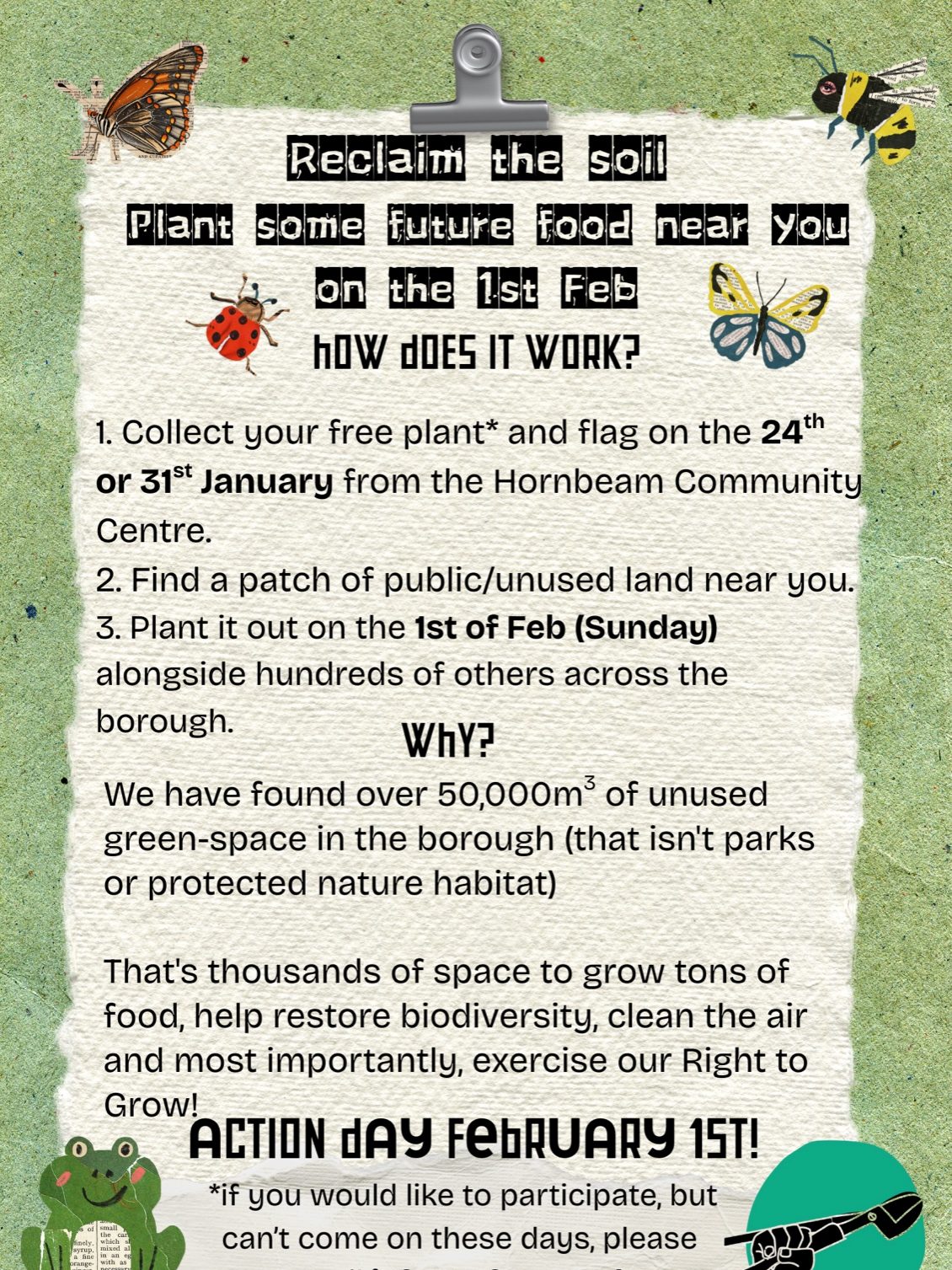
Reclaim The Soil – 1st February 2026
Is there a patch of land near you which could do with some love? There’s lots of public space in the borough being left unused – we’re going to do something about that! Reclaim the Soil is about taking matters into our own hands, getting them dirty and connecting to the land.
- Collect your free plant and flag on the 24th or 31s January from the Hornbeam Community Centre.
- Find a patch of public/unused land near you.
- Plant it out on the 1st of Feb (Sunday) alongside hundreds of others across the borough.
-

Space to Grow report from RHS
Fantastic to see the RHS “Space to grow: realising the potential of the community gardening movement” report which came out in October and how it highlights the importance of community gardening especially in urban areas” Community gardening in the UK has grown and evolved over time… Community gardening groups come in many shapes and sizes, such as allotments, health centre gardens, school gardens and even shared containers on streets and shared spaces in housing developments. Of those surveyed, 76% are located in urban areas, while the remaining 24% in rural settings.” The report notes “… the top motivation for community gardening groups is bringing the community together – in 85% of cases. This is followed by benefitting participants’ physical and mental wellbeing, encouraging enjoyment of gardening, improving biodiversity and wildlife habitats and creating cleaner, greener or more attractive surroundings.” And continues ” … community gardens are helping us tackle some of the biggest issues of our time, particularly in policy areas that have long been priorities for government: improving people’s health and wellbeing, fostering place-based community cohesion, increasing access to nature and delivering on environmental targets. The body of research pointing to the benefits and impacts of community gardening continues to grow.” I could not agree more! So whether you are engaged in delivering biodiversity gain, or improving health or diet, food kitchens, reducing food waste and composting, or working with mental wellbeing or increasing access to nature, community food growing does this for you! While doing the same for your colleagues in other departments. For Local Government the report states Recommendations for local government
1) Create a local strategy for community gardening
Taking a strategic approach to supporting community gardening would help local authorities and regional mayoralties to deliver against their policy priorities for local residents – including improving health and wellbeing, uniting communities, developing a strong sense of place, restoring nature and delivering on climate-related goals.Some local authorities have recognised the impact supporting community gardening can have in their areas and are already leading the way with their own strategic approaches to supporting local growing. Southwark Council has appointed two Community Gardening Coordinators to support a network of local community gardens; Greater Manchester Combined Authority has invested millions through its Green Spaces Fund, and East Suffolk’s ‘Field to Fork’ scheme is helping communities grow their own food.
These forward-thinking initiatives highlight the potential of taking a strategic approach to supporting local community gardening.
2) Use the Right to Grow to deliver against local policy priorities Incredible Edible’s Right to Grow campaign urges local authorities to make it easier to identify and access public land suitable for community growing or wildlife projects. It also calls for a simpler process for groups to secure free leases to cultivate the land, and for those groups to have the opportunity to bid if the land is put up for sale.
Right to Grow offers a tangible opportunity for local authorities to deliver on their policy priorities in areas such as wellbeing and social cohesion by supporting local people to grow in their communities. In addition, by enabling community groups to take over underused public spaces, councils could save maintenance costs – which could be repurposed to directly support community growing.
Recommendation:
Local authorities should consider how creating a local strategy for community gardening, or incorporating community gardening into existing strategies, could help them deliver their policy priorities for local residents.Recommendation:
Local authorities should consider how they could deliver on their policy priorities and ‘green the grey’ by adopting Right to Grow.The Right to Grow campaign has captured national political attention and continues to build momentum at a local level, with six local authorities adopting Right to Grow to date – including Hull and Bury. The more local authorities that adopt Right to Grow, the more barriers will be dismantled for community growers trying to access land and the more councils will be able to utilise the power of the community gardening movement to help them deliver their policy priorities.”
https://www.rhs.org.uk/get-involved/community-gardening/spacetogrow -

What if we had the Right to Grow?
Up and down the country public land is being left unloved, costing our local authorities money to care for and giving nothing back to the community in return. Community groups like Incredible Edible have shown that with a little imagination, bravery and TLC these parcels of land can be turned into oases for food and wildlife.
It’s time we were afforded a Right to Grow; an opportunity to take up our seed packets, spades and watering cans, and nourish our communities, without all the hoop-jumping and red-tape so often encountered by those who want to get on and grow food with and for their community. The Right to Grow calls for a new relationship that builds trust between councils and communities, and sees authorities recognise the immense value that community food growers bring to the places we call home. With special thanks to University of Sheffield and Research England for funding the production of this film.
🌱 Find out more about the Right to Grow: https://www.incredibleedible.org.uk/w…
🌱 Report: Benefits of the Right to Grow: https://www.incredibleedible.org.uk/w…
🌱 Council briefing on the Right to Grow: https://www.incredibleedible.org.uk/w…
🌱 How Right to Grow supports existing council policies: https://www.incredibleedible.org.uk/w…
🌱 Join the Right to Grow mailing list and Learning Network: https://mailchi.mp/incredibleedible/n…
-

Hackney Right To Grow Public Meeting
Hackney Right to Grow has an open meeting for those who are interested in the campaign and especially if they want to get involved. Wedesday 17th September, 7pm at the Garden of Earthly Delight on Graham Road.
-

GLA Environment Committee
Essential reading re London and food growing. The report of the GLA Environment Committee
“The ’Right to Grow’
The Committee also heard that giving local communities the ‘right to grow’ offers a potential model for expanding access to food growing across London. It follows a similar principle to the approach taken in Southwark – by calling on local authorities to set up a simple process by which communities can apply to access suitable land for food growing.”